
Here’s how it usually goes. Orders start picking up, and for a few weeks it feels great. Then you’re packing parcels at lunch, replying to customers from your phone, and tweaking ads at midnight. SEO? Not a chance, it hasn’t been touched in months. At some point you have to hand a chunk of this over, and the only real question is who gets it.
So, two options. An agency, or one good freelancer. I don’t think either is the “right” answer for everybody. Your budget matters a lot here, and so does how big the store is today, not how big you hope it’ll be next year. Below I’ll cover how each one works, where they let people down, and what I’d look at before choosing in 2026.
What Is a Shopify Marketing Agency?

Simple version: you’re paying for a team instead of one person. Most have a strategist who builds the plan, a media buyer spending your ad money, a designer, a copywriter, and someone on analytics checking whether any of it paid off. Some call themselves a marketing company, some a firm, some just a Shopify agency. Honestly, the name doesn’t matter. What you get is a group that knows the platform and how Shopify shoppers behave.
Services a Shopify marketing agency usually offers
Honestly, every agency’s menu looks a bit different. Still, the same handful of services keeps showing up, and the good ones don’t sell them as separate boxes to tick.
Start with the boring stuff, SEO. Slow store? Messy collection pages? That’s usually the first fix, and blog content comes after. Ads are the loud part. Google, Meta, TikTok, maybe Pinterest. And here’s what owners learn the hard way: an ad you launch and forget will eat your budget quietly. Someone needs to watch it every week.
Email and SMS get less attention than they deserve. Welcome emails, abandoned carts, that sort of thing. For stores where people buy once and never return, it can be the cheapest growth you’ll find, so a few agencies do only this. Drop shipping is its own animal, though. Thin margins, slow suppliers, so you can’t copy a normal flow and hope.
CRO sounds fancy but it’s simple. They test your pages and checkout, and keep changing things until more people buy. Some agencies also run content for big Shopify Plus stores. Then reporting ties it together. Revenue, cost per customer, lifetime value. Numbers, not guesses.
Don’t want to be involved? Ask for fully managed work, one team, start to finish. Some will even get you onto Amazon too. Skip the “app marketing” agencies though. They promote apps in the Shopify App Store, so they’re no use to a regular merchant.
Shopify digital marketing agency vs Shopify advertising agency
The two names sound close, but they cover different ground. Think of a Shopify digital marketing agency as the all-rounder, looking after SEO, email, content, social and ads together. A Shopify advertising agency is the specialist who mostly lives inside Google, Meta and TikTok campaigns.
The right pick depends on your store’s situation. Say your organic traffic is already healthy and the only thing you want is more ad volume. In that case an advertising agency could be plenty. If you’re planning growth that builds over a year or two across several channels, the best Shopify digital marketing agency for you will be one that links search, email, content and ads into a single plan. When you talk to agencies, ask which model they follow. Their answer tells you a surprising amount about how they price and report.
Who Are Shopify Marketing Experts? (Freelancers and Specialists)
Shopify marketing experts are independent people, freelancers or small consultancies, who concentrate on one or two areas of ecommerce marketing. Nobody sits between you and them, so you speak directly to the person doing the work. Many of the best Shopify marketing experts have spent years in one channel, paid social or email for example, and they’ve got very good at it.
Where they’re based can matter too. For a store selling mainly to North America, it’s worth looking for Shopify marketing experts in the USA, because they already know what local shoppers expect and which holidays drive sales.
Types of Shopify experts (SEO, email, paid ads, CRO)
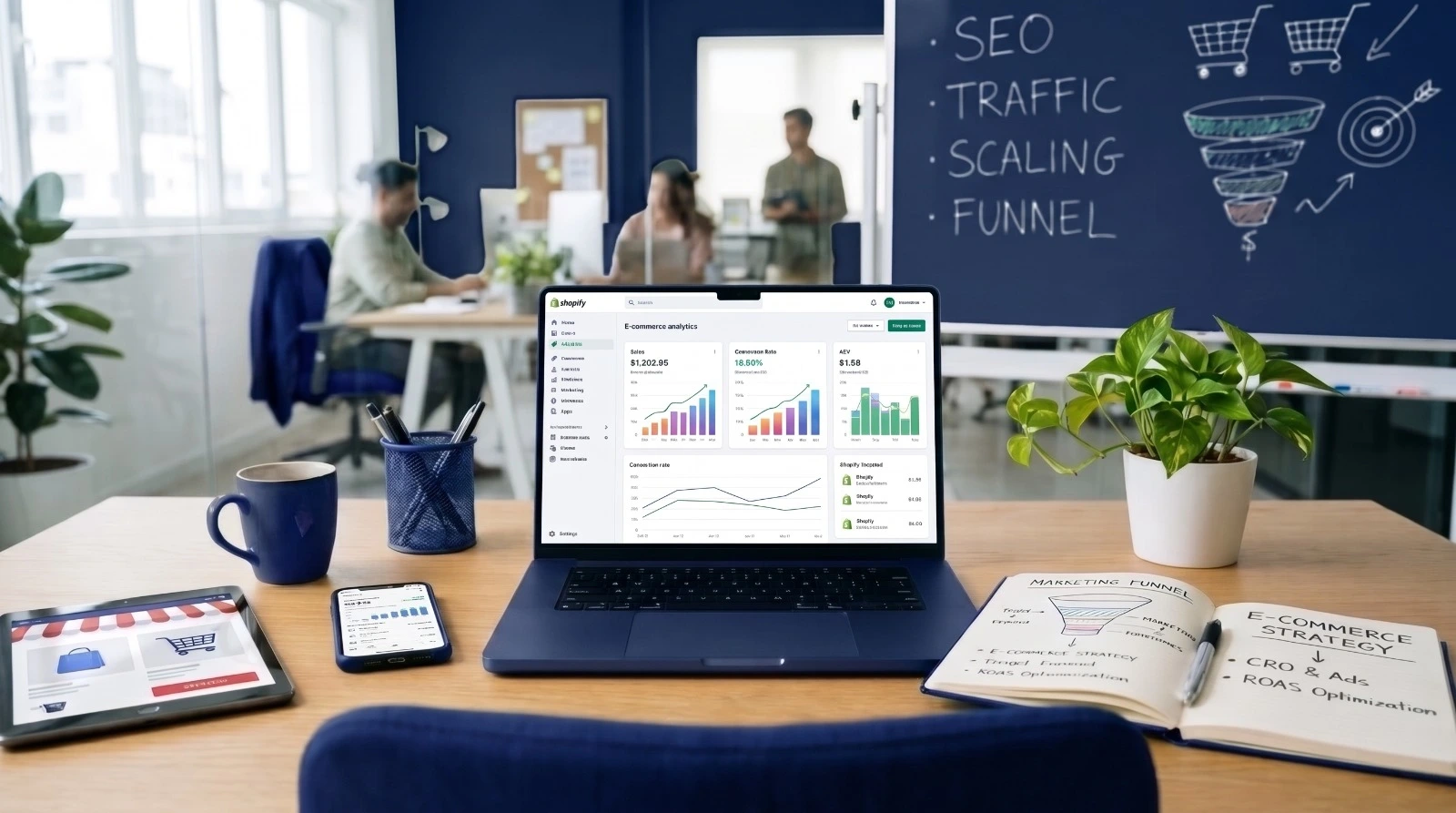
You’ll keep running into the same few specialists. The SEO person cares about how healthy your site is, plus keywords, product descriptions and backlinks. Email and SMS people build the automations that bring old customers back. Then there are the paid ads folks, who live inside Meta, Google and TikTok and obsess over return on ad spend. CRO folks work differently. They sit and watch what shoppers do in your store, find the spot where people give up, and keep testing small fixes until more of them check out.
Then there’s Shopify Plus, which is its own world. These specialists handle complicated setups, heavy automation and catalogs of thousands of products. And at the very top, enterprise experts help big brands keep several teams pulling in the same direction.
When a single expert is enough
Plenty of stores never need more than one specialist. Picture a small boutique whose only real problem is weak email flows. A ten-person team would be overkill. The same goes for the best Shopify marketing experts for small clothing boutiques in the US, who tend to be freelancers that understand the fashion calendar, influencer culture and how shoppers browse on their phones.
An expert also suits you if the budget is tight, if you’d like a direct line to whoever’s doing the work, or if you’re happy to steer the overall strategy yourself. Many of them work alongside the best Shopify apps for marketing, such as email platforms, review tools and loyalty programs. If you’re comparing the best Shopify marketing apps in 2026, remember that even the best Shopify marketing app only automates tasks and can’t set your strategy. Leading Shopify marketing integration solutions can link all those tools together, yet a human still has to choose the message, the audience and the send time.
Shopify Marketing Agency vs Experts: Key Differences
Both routes can bring results, though they differ in a few ways that matter. We’ll look at four of them, then sum things up in a table.
Cost and pricing models (retainer vs hourly vs project)
Most agencies bill you monthly, a flat retainer. Some also want a slice of your ad spend or a setup fee on top, and that’s where people get caught out. Before signing, ask for a written list of what each month actually covers. Freelancers are different. They’ll usually charge by the hour or by the project, and some offer a small monthly package if you need them regularly.
On price alone, the expert wins. Value is another matter, though. The agency fee covers a team, someone managing the project and the software they use, while the expert fee covers a single person’s time. Rates differ a lot between markets and experience levels, so collect written quotes from at least three providers before you choose anyone.
Team size and range of skills
This is the biggest split between the two. With an agency, people with different skills plan your SEO, ads, email and design together. An expert goes deep on one thing and may need help with the rest. Hire several experts and you’ll find yourself acting as project manager, chasing each of them for updates.
Speed, communication and accountability
Experts can often start quickly and reply straight away, since there’s no account manager in the middle. Agencies take longer to onboard, but they come with structure, like regular calls, shared dashboards and a colleague who can step in when someone’s away. With a freelancer, a week off sick or a full diary can freeze your campaigns. In an agency, responsibility is shared across the team, and the contract normally sets out what you’re owed.
Scalability as your store grows
Your needs won’t stay put. Say your store makes modest money today. A year from now it might need campaigns on several channels, sales in other countries or a much larger content program. An agency can put more specialists on your account when that happens, while an expert can only stretch as far as their own hours allow, which is when you’d have to add someone or switch.
Agency vs Expert at a glance
Agency | Expert | |
What you pay | Monthly retainer, sometimes plus a cut of ad spend | Hourly, per project, or a small monthly deal |
Who works on it | A whole team: SEO, ads, email, design | One person, strong in one or two things |
How fast you start | A few weeks of onboarding | Often within days |
Who you talk to | An account manager, plus regular reports | The person doing the work |
If someone’s out | Somebody else covers, and the contract backs you up | Your campaigns wait |
Room to grow | Easy to add channels and people | Stops at one person’s hours |
Good fit if | You’re growing and need several channels | You’ve got one clear job and a tight budget |
What You Get (and Give Up) With an Agency
It’s worth weighing both sides before you commit to a contract. On the plus side, you get a full team, so SEO, ads, email and CRO can run side by side, and the reporting, processes and project management are already set up. If someone leaves or falls ill, your campaigns don’t stall. Agencies have also seen plenty of stores, so they tend to dodge the usual mistakes, and they can expand their work as your store grows.
The downsides are real, though. The monthly fee is normally higher than a single expert would charge, and a small account can get lost at a big agency. Some contracts come with minimum terms. You may also end up speaking only to an account manager, not the person who runs your ads, and a few agencies hand every client the same playbook.
Pros and Cons of Hiring a Shopify Marketing Expert
An independent expert brings trade-offs of their own. The main attraction is cost: it’s usually cheaper, and you can pay for just the work you need. Another plus is talking straight to whoever does the work, and a good freelancer can usually turn small jobs around quickly. Someone who has spent five years inside Meta Ads Manager will probably know it better than a generalist does.
The trade-offs start with coverage. Nobody can be excellent at every channel, and freelancers have limited hours, so a bad week or a full calendar means delays. Use several of them and you become the manager who has to keep them all moving. It’s also hard to judge quality before you hire, since results vary a lot from one freelancer to the next. And if the store grows quickly, it may outgrow what one person can handle.
Which One Should You Hire? (Based on Your Store Stage)
Ignore what’s fashionable. The right choice depends on where your store is at the moment. Here’s the short version, with the reasoning underneath.
Which one fits your store right now?
Where your store is | Who to hire | Why |
Just starting out | One expert, or a small agency | It costs less, and you only need help on a channel or two |
Growing quickly | An agency | You need several channels, testing and proper reports |
Shopify Plus or enterprise | A specialist agency, with your own team alongside | Huge catalogs, automation and big budgets need more hands |
If you’re just starting out
When you’re just getting started, money is tight and the goal is simple: get steady traffic and a few early sales. One caveat: if the store itself is slow or converts badly, marketing spend just makes the leak bigger, fix the build first. An expert who’s strong in one channel, like email or paid social, is often a smart first hire. You can look at the best Shopify marketing agencies for small businesses too, but only if one offers a lean package. Many agencies set minimum budgets that a new store can’t meet. And if you run a drop shipping store, be careful with long contracts until your product and margins are proven.
Growing and scaling brands
Once people clearly want what you sell, the job changes. You’re not hunting for your first customers anymore. The problem now is growing without setting cash on fire, and that’s usually when an agency starts to earn its fee. A decent one will run ads, email and SEO at the same time, and it’ll test new creative quickly. More importantly, it can tell you which channel is actually paying for itself and which one is just eating the budget. If you make spending decisions from numbers, pay a bit more for an agency that’s serious about data. The good ones set up tracking in the first week, not after three months of guessing.
Shopify Plus and enterprise stores
Bigger stores need more than campaigns. There’s integration work, automation, sign-off from three different people, and usually several teams all moving at once. At this size you want an agency that has already dealt with enormous catalogs, stores in multiple countries and ad budgets that would scare most owners. A setup I come across a lot: an in-house team, an agency on top of it, and a freelancer or two for narrow jobs like technical SEO or email.
How to Choose an Agency You Won’t Regret
Say you’ve settled on an agency. Now comes the harder bit, comparing them. Don’t pick the one with the biggest name just because it’s big. Pick the one that fits your goals, your budget and how you like to communicate. Here’s what I’d check first.
Check certifications and Shopify Partner status
Look for an agency with certified people, ideally one in the Shopify Partner Program. Partner status doesn’t prove the work is good, but it suggests the team has spent real time learning how the platform works.
Ask these questions:
Who actually holds the certifications?
How long have they worked on Shopify stores?
Have they handled products like yours before?
A good agency will be happy to answer these. If the answers are vague, take note.
Review case studies, ROAS, and results
Case studies show what an agency has actually done. Look for real numbers, such as revenue growth, return on ad spend (ROAS), customer acquisition cost (CAC), and conversion rate. Each case study should also state the timeframe and the strategy behind the results.
If paid social is your main channel, ask to see work from an agency that specializes in it, and ask how the results were measured. If landing page design is your priority, ask for before-and-after tests.
Where possible, talk to current or past clients. A result with no context should make you suspicious.
Ask about reporting and analytics

Reporting is where a lot of agency relationships quietly go wrong, so raise it before you sign anything. How often will reports land in your inbox? What will they actually contain? And will someone walk you through the numbers, or are you left to decode a spreadsheet on your own?
You’ll usually see two styles. Some firms offer Shopify marketing services with an analytics platform, so you can open a live dashboard any time you want. Traditional agencies usually go the other way and email a monthly slide deck. Neither style is better by default. A dashboard gives you openness, while a written report often comes with context that a chart can’t give you. What you can’t compromise on is clarity. You should be able to follow a dollar from ad spend to revenue, and the agency should be able to tell you which numbers are just for show, like impressions, and which ones touch your profit. The best performance marketing solutions for Shopify merchants always come back to sales
Red flags to avoid
Some warning signs show up early. The biggest one is any promise of guaranteed rankings or guaranteed sales, because nobody controls Google or your customers’ wallets. Be careful too if the agency can’t say clearly where your budget will go, if there’s no written scope of work, or if the contract is built so that leaving costs you a penalty.
A few smaller things deserve a raised eyebrow as well. Case studies that never mention a single metric. A rush to get your signature this week. Reluctance to give you access to your own ad accounts and reports. And one identical package pitched to a fashion store and a hardware store alike
Best Ecommerce Agencies Compared (2026)
Search for the top Shopify marketing agencies in 2026 and you’ll land on endless lists. Many of them are ordered by company size, or by who paid for the top spot, which tells you very little about fit. It’s smarter to decide what you need first and then hold each agency up against that. The same approach helps when you’re trying to find a top ecommerce digital marketing company for Shopify, because it keeps you from being swayed by a slick website.
What to compare: services, pricing, industries, results
Once you’re down to a shortlist, put the same four questions to every agency and keep notes. Side by side, the answers tell you a lot.
Criteria | What to check | Good sign | Red flag |
Services | Do they cover everything you need? | In-house strategy, design, development, ads, email/SMS, SEO, and reporting | Core work is outsourced, or you’ll need a second company to fill gaps |
Pricing | Is the retainer in writing, and what does it include? | Written scope with listed deliverables | No written scope, or ad management and custom reports billed as extras |
Industries | Have they worked with stores like yours? | Case studies from similar-sized stores in your category | No relevant experience, or only work in unrelated niches |
Results | Can they back up their claims? | Real data, before-and-after numbers, and an explanation of their method | Big percentage claims with no data or methodology behind them |
Use the same list for the best Shopify marketing agencies in 2026 and for smaller shops that don’t appear on any list yet. A young agency with great results can easily beat a famous one that treats you like a number.
Comparison table of agency types
Agencies come in several shapes. Here’s a quick look at the main kinds you’ll meet.
Agency type | Best fit | Strengths | Trade-offs |
Full-service digital agency | Brands that want one team to run everything | SEO, ads, email and content planned together | Higher cost, and some set a minimum spend |
Paid media or advertising agency | Stores with a proven product and a budget for ads | Ad creative testing, bidding and close ROAS tracking | Little help with SEO or email |
Email and SMS specialist | Stores whose customers tend to buy again | Flows, segmentation and keeping buyers engaged | Weaker at bringing in brand-new customers |
Shopify Plus agency | Large and enterprise stores | Complex builds, automation and integrations | Premium pricing and longer projects |
Regional or local agency | Brands that want a team who knows their market | Local knowledge and a shared time zone | A smaller team and narrower services |
Shopify Marketing Agency in the USA: What to Know
The US is the biggest market for a lot of Shopify merchants, so it’s no surprise that good agencies are in demand. If you choose a Shopify marketing agency in the USA, a few practical things work in your favor. Calls happen during your working day. The team already understands how American shoppers behave, including the rush around Black Friday and Cyber Monday. They’re also familiar with the rules on email and SMS, such as getting proper consent before you message someone. For a store that sells mostly to Americans, those details save time and prevent mistakes that cost real money.
Don’t assume location settles it, though. Plenty of small regional firms give a store more attention than a big national name with hundreds of clients ever could. Some merchants even search by city. Say your boutique sells mostly around Los Angeles. Typing in Shopify marketing agency in Beverly Hills isn’t unreasonable, because that team sees the same shoppers you do. Over in Britain it’s much the same, with brands hunting for top Shopify marketing agencies in the UK so nobody has to explain VAT or next-day delivery from scratch. Whichever way you lean, ask to see results first. A nice office address won’t raise your sales.
Shopify Stores That Inspire: What Great Marketing Looks Like
A handful of well-run stores can teach you more than another how-to guide. You’re not there to copy them. Just notice how they find buyers, what story they tell and why people come back for a second order. Take those notes into every call with an agency or an expert, and you’ll know exactly what to ask for.
Examples from top Shopify stores
Gymshark is a good place to start. It grew by working with fitness creators and building a loyal community, and plenty of its customers ended up promoting the brand for free. Allbirds is a different story. It sells wool sneakers and shows the carbon footprint on its product pages, so the sustainability pitch is right in front of you at the moment you’re about to buy. Kylie Cosmetics relied on scarcity. Launches came in limited batches, and shoppers learned not to hesitate.
Look closely and the three have something in common. Each has a voice you’d spot without the logo, and none of them rests on one clever trick. Content, reviews, email and paid ads all say the same thing in the same tone. A good Shopify store marketing agency or a skilled expert should be able to build that kind of joined-up setup for you
Lessons you can copy for your own store
None of this needs a big budget.
Start with your story. If a stranger can’t tell within a few seconds why they should buy from you, fix that before you spend more on ads. Then lean on real people. Reviews help, and so do photos from customers who actually bought the thing. A creator showing the product in their own videos works too. Most shoppers trust that kind of proof over a studio shot. Email and SMS matter just as much. A second purchase from someone who already knows you is far cheaper than hunting down a stranger.
The basics count too. If your pages crawl, your photos look blurry or checkout takes five steps, you’re losing sales every day. Fixing that is usually cheaper than buying more traffic. Once it’s sorted, glance at revenue, customer acquisition cost and lifetime value every so often. If one of them slips, check why before you change the budget.
Whether you pick an agency or an expert, make sure they’ve looked at your actual store before they send a proposal. A generic pitch is a bad sign. Ask plenty of questions on the first call, then go with the team that’s honest about what it can and can’t do. Want a second opinion while you compare? The team at Xperts5 is happy to talk through your goals and work out what suits your Shopify store.
Frequently asked questions
Yes, absolutely. In 2026, Shopify remains the leading e-commerce platform because of its unmatched ecosystem, robust app integrations, seamless checkout speeds, and advanced capabilities (like headless setups and built-in AI tools). While competition is high, it gives growing brands the exact infrastructure needed to scale without building a store from scratch.
Most stores fail not because of the platform, but due to three main pitfalls: targeting the wrong audience, poor conversion rate optimization (CRO) causing traffic to bounce, and bleeding ad spend without proper tracking (ROAS). Many merchants also scale ads before locking down product-market fit or retaining past buyers through email/SMS.
High-converting categories usually solve a specific, recurring problem or tap into passionate communities. This includes niche apparel (like activewear and custom patches), beauty and personal care items, eco-friendly goods, and functional home products. The common thread isn't just the product, it's strong visual branding and a seamless mobile shopping experience.
A freelancer is almost always cheaper upfront. Freelancers typically charge by the hour or project, making them ideal for tight budgets or single-channel tasks (like setting up an email flow). Agencies charge higher monthly retainers because you are paying for a multi-disciplinary team, structured project management, and cross-channel strategy.
You should upgrade to an agency when your store is growing quickly, you are actively running campaigns across multiple channels simultaneously (Meta, Google, SEO, Email), and you need data-driven reporting to manage a larger budget. If you are just starting out or only need one specific fix, a freelancer is usually the smarter entry point.
Yes, this is actually a common setup for mid-market and Shopify Plus brands. A mature brand might keep an agency on retainer for high-level media buying and creative strategy, while hiring individual freelancers for hyper-specific or technical jobs, such as custom Next.js development, advanced technical SEO audits, or localized copywriting.