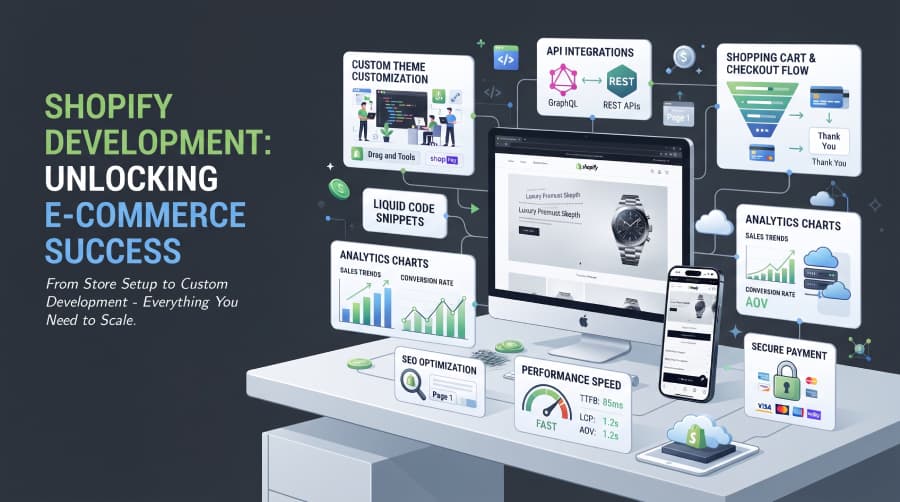
If your Shopify store looks fine but isn’t converting, the problem usually isn’t your products it’s the development behind the storefront. A generic theme with a few color tweaks can get you online fast, but it rarely holds up once you’re running ads, adding apps, and trying to move customers from browsing to checkout.
Shopify development is what separates a store that technically works from one that actually grows a business. This guide breaks down what it involves, what it costs, and how to know if you need a developer at all or a full Shopify development company behind you.
What Is Shopify Development?
Shopify development is the process of building, customizing, and maintaining an online store on Shopify beyond what the drag and drop editor can do on its own. It covers everything from theme customization and custom app development to API integrations and full Shopify Plus builds.
Where basic store setup deals with picking a theme and uploading products, shopify development in the fuller sense means writing custom code in Liquid (Shopify’s templating language), connecting third party systems, and shaping the store’s architecture so it can scale as order volume grows.
In short: Shopify makes starting a store easy. Shopify development is what makes that store fast, flexible, and built around how your business actually operates.
Why So Many Brands Build on Shopify
A few reasons Shopify remains the default choice for growing ecommerce brands:
Hosting and security are handled for you. No servers to manage, SSL built in.
A massive app ecosystem covers almost any feature you’d want to add.
It scales. The same platform that runs a five product store can run a multimillion dollar Shopify Plus operation.
The talent pool is deep. Because so many stores run on it, finding an experienced Shopify developer or Shopify development agency is far easier than for niche platforms.
That said, Shopify’s flexibility is also where things get complicated which is exactly where development services come in.
Signs Your Store Needs Shopify Development

Not every store needs a full custom build, but a few patterns usually mean it’s time to move past the default theme:
Site speed drops: Every time you add a new app or feature.
You’re stitching together multiple apps: To replicate one workflow that should be simple.
Your pricing, bundling, or checkout logic: Doesn’t fit standard theme settings.
Mobile conversion lags behind desktop: And theme settings alone haven’t fixed it.
You’re planning to scale: More products, more markets, more traffic and aren’t confident the current setup can keep up.
If two or more of these sound familiar, investing in proper development now is usually cheaper than continuing to patch around the same limitations.
The Core Services Under Shopify Development

“Shopify development” isn’t one service it’s a handful of related disciplines that usually work together.
Shopify Theme Development
This is where design meets code. A developer takes a theme (or builds one from scratch) and shapes it around your brand, your product catalog, and your conversion goals not just how it looks, but how fast it loads and how it behaves on mobile. If your site currently feels “templated,” this is usually the fix, and it’s also where your brand identity has to hold up under real use something worth planning alongside your branding and creative direction.
Custom Shopify Development
Sometimes an app or theme setting just can’t do what your business needs. Custom shopify development covers bespoke features unique product configurators, custom pricing logic, nonstandard checkout flows built specifically for your store rather than bolted on with a generic app.
Shopify App Development
If you need functionality that doesn’t exist in the App Store, or you want to avoid stacking five different apps that slow your site down, a custom built private app is often the cleaner long term solution.
API & System Integrations
Most growing stores eventually need Shopify talking to something else an ERP, a CRM, an inventory or fulfillment system. This is handled through Shopify’s REST and Graph QL APIs, and it’s usually where “just use an app” stops being enough.
Shopify Plus Development
For high volume or B2B brands, Shopify Plus unlocks custom checkout, multi-store management, and deeper automation but it also requires a developer who understands its more complex architecture.
Our Experience With Shopify Development
Shopify development isn’t a side offering for us it’s a core part of what we do at Xperts5, alongside SEO, paid media, and creative under one roof. Our team has built stores across fashion and apparel, beauty and cosmetics, health and wellness, subscription boxes, and B2B / Shopify Plus operations, and our builds run with an average page speed score of 92% and an 88% checkout completion rate.
We’re recognized Shopify Experts, and every project regardless of size runs through the same structured process, so nothing gets skipped between the first call and post-launch support. If part of your project extends beyond Shopify itself, our web development and CMS development teams handle that side without you needing a second agency.
Shopify Development Services vs. DIY: What’s the Real Difference?
You can absolutely build a Shopify store yourself with a paid theme and a weekend. The question is what you’re optimizing for.
DIY / Theme Only | Professional Shopify Development | |
|---|---|---|
Speed to launch | Fast | Slower, but built to last |
Customization | Limited to theme settings | Fully custom, matches your workflow |
Performance at scale | Struggles under traffic/complexity | Built for growth |
Ongoing cost | Lower upfront | Higher upfront, often lower longterm |
DIY makes sense for a simple catalog and a tight budget. Once you’re running paid traffic, integrating other systems, or trying to stand out in a crowded niche, a shopify development company earns its cost back through conversion rate and reliability alone.
Not sure which side of that line your store is on? Talk to a Shopify specialist and we’ll give you a straight answer.
How a Shopify Development Project Actually Runs
Most solid Shopify development services follow a similar four stage process:
Discovery & Scope: Mapping your products, goals, integrations, and technical requirements before any code is written.
Design & Theme: Turning that scope into a storefront, from wire-frames through to a fully coded, mobile first theme.
Build & Integrate: Developing custom functionality, apps, and integrations, then testing products, payments, and workflows end-to-end.
Launch & Support: Going live, then monitoring performance and iterating as your catalog and traffic grow.
Skipping the first stage is the most common reason Shopify projects run over budget decisions made without a clear scope tend to get expensive to unwind later.
Shopify Development Trends to Watch in 2026
A few shifts worth factoring into any new build:
AI driven personalization. Stores tailoring product recommendations and content to each visitor are seeing meaningfully higher conversion rates.
Headless and Hydrogen builds. Separating the frontend from Shopify’s backend can push mobile speed scores well above what standard themes achieve.
Mobile first by default. With most traffic now coming from phones, even small speed improvements translate directly into more completed checkouts.
PWA style experiences. Stores that feel app like without requiring a download are becoming a differentiator, especially for repeat purchase brands.
None of these are reasons to overengineer a simple store but they’re worth discussing with your developer before you lock in a build.
How Much Does Shopify Development Cost?
Pricing varies widely depending on scope:
Basic theme setup and minor customization: Suitable for businesses that need small design adjustments and standard Shopify configuration.
Custom theme design and advanced storefront development: Ideal for brands looking for a unique design, tailored functionality, and an enhanced user experience.
Custom app development and third party integrations: Best for businesses requiring specialized features, workflow automation, or seamless integration with external platforms.
Enterprise level Shopify Plus development: Designed for high growth businesses that need advanced customization, scalable infrastructure, and complex eCommerce solutions.
Freelancers tend to be cheaper for small, well-defined tasks. Agencies cost more but bring project management, QA, and design together which matters once a project has more than one moving part. The number that matters most isn’t the hourly rate anyway it’s total cost against outcome. A cheaper build that takes three revisions to get right, or that can’t handle Black Friday traffic, usually ends up costing more than paying properly the first time.
Want a real number instead of a range? Get a free project estimate no obligation, just a straight answer on scope and cost.
How to Choose the Right Shopify Development Company
A few things worth checking before you hire:
Do they show real, complex builds not just theme installs in their portfolio?
Do they understand your industry’s specific needs (subscriptions, B2B pricing, high SKU counts)?
Is design part of the process, or just development? A store’s visual identity and branding matter as much as its backend.
What happens after launch? Ongoing support and performance monitoring should be part of the conversation, not an afterthought.
Common Shopify Development Mistakes to Avoid
A few mistakes that show up again and again in Shopify projects gone wrong:
Skipping the discovery phase to launch faster, then paying for it in rework later.
Over installing apps instead of building or consolidating one clean feature.
Treating mobile as an afterthought rather than the primary experience.
Choosing a developer on price alone, without checking real, complex past work.
No post launch plan, leaving a store unmonitored right when traffic and issues start showing up.
Most of these come down to one thing: rushing the planning stage to save time upfront, then losing far more time fixing it down the line.
Is Shopify Plus worth it for a smaller store? Usually not. Plus is built for high volume, B2B, or multi store operations a standard Shopify plan with solid custom development covers most growing brands just fine.
Final Thoughts
Shopify makes it easy to get a store online. Shopify development is what makes that store actually work for your customers, your operations, and your growth plans. Whether you need a single custom feature or a full Shopify Plus build, the right approach starts with a clear scope and a team that’s built stores like yours before.
Talk to a Shopify specialist and we’ll map out exactly what your store needs
Frequently asked questions
It’s the custom design, coding, and integration work that turns a Shopify store from a generic template into something built specifically around your products, workflows, and growth plans.
Both. Shopify’s App Store and drag and drop editor make simple stores easy, but its APIs and Liquid templating support fully custom, enterprisegrade builds too.
Most projects run two to twelve weeks, depending on how much custom design, functionality, and integration work is involved.
You can migrate basic data yourself, but a developer ensures products, customers, orders, and SEO settings move over cleanly with minimal downtime.
An individual developer usually fits small, well scoped tasks. An agency brings design, development, QA, and project management together better suited to larger or more complex builds.
It should be. Mobile first design isn’t optional anymore responsive performance needs to be built in from the start, not patched on afterward.
Usually not. Plus is built for high volume, B2B, or multistore operations a standard Shopify plan with solid custom development covers most growing brands just fine.