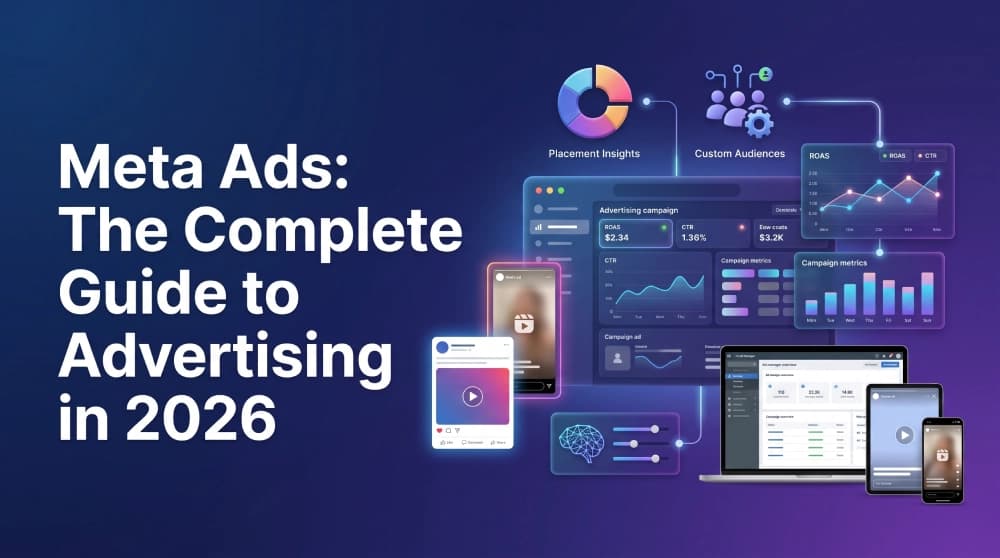
Meta Ads power advertising across Facebook, Instagram, Messenger, and the Audience Network, giving businesses of every size in the USA a way to reach billions of active users with highly targeted, data-driven campaigns. Whether you are launching your first campaign or refining an existing strategy, this guide from Xperts5 walks through everything from setup to optimization, drawing on real campaign data and empirical testing instead of theoretical frameworks. By the end, you will have a clear understanding of how Meta Ads work, how to structure a Meta Ads campaign correctly, what the typical costs look like, and how hidden inefficiencies that erode your ad spend.
What Are Meta Ads?
Meta Ads are paid placements shown across Meta's family of apps — primarily Facebook and Instagram, but also Messenger and partner apps in the Audience Network — managed through a single platform called Meta Ads Manager.
Inside Ads Manager, you build campaigns, set objectives, define audiences, and control budget and bidding. A related free tool, the Meta Ad Library, lets anyone browse live ads from any advertiser — a valuable competitive reference before you build your own creative, since you can see exactly what competitors are running right now.
Unlike organic posts, Meta Ads are shown based on targeting data — interests, behaviors, demographics, and past interactions with your business — instead of relying on people already following you.
Meta Ads vs Facebook Ads vs Instagram Ads
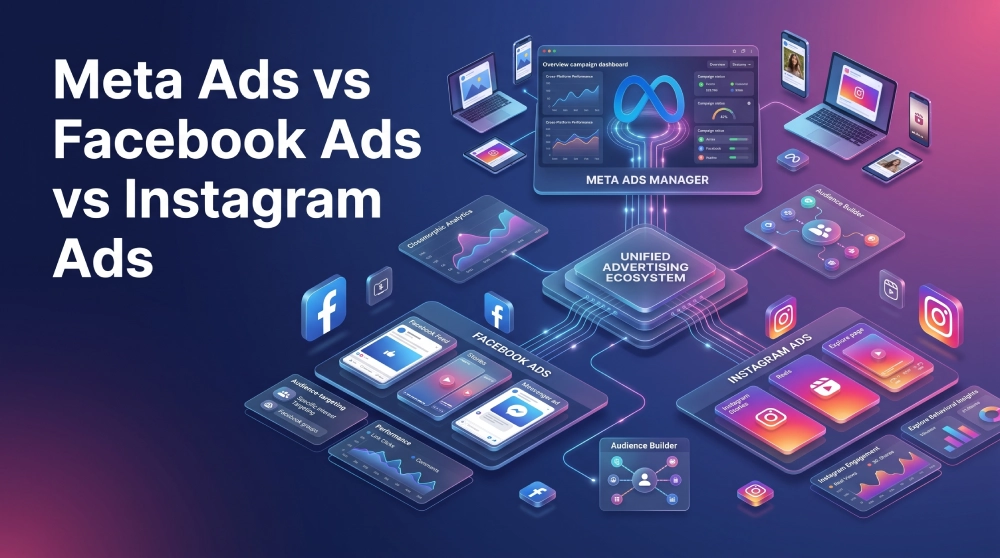
These terms are often used interchangeably, but there is a real distinction:
Meta Ads are the umbrella term for all advertising across Meta's platforms
Facebook Ads — ads that display natively on Facebook only
Instagram Ads — ads served specifically on Instagram
When you build a campaign in Meta Ads Manager, you choose whether it runs on Facebook, Instagram, both, or across all placements. One system handles delivery everywhere, even if you happen to be logged into Ads Manager through your Instagram account.
How Meta Ads Work
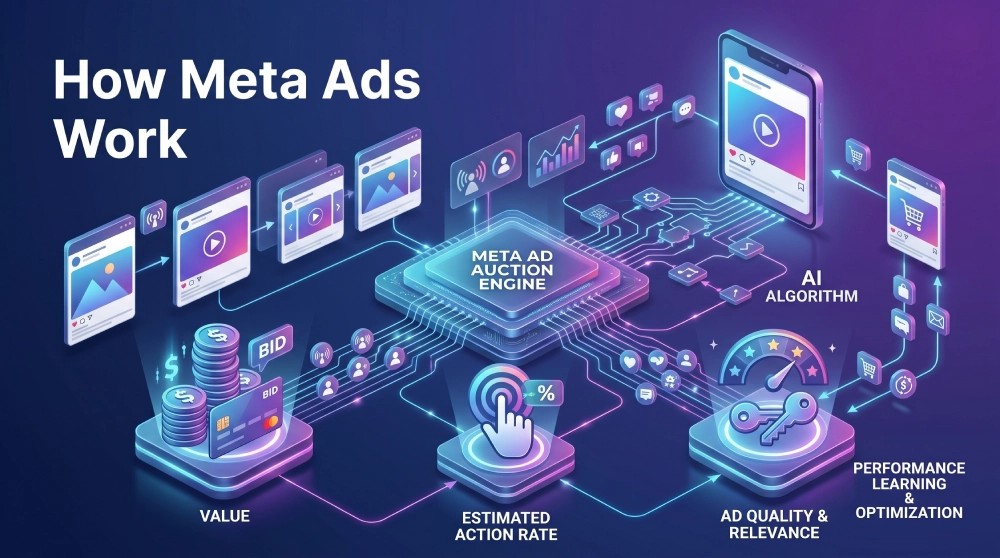
Every time someone opens Facebook or Instagram, Meta runs an ad auction in the background. This auction decides which ads to show. This auction is not just about who bids the highest; Meta's algorithm weighs three main factors:
Bid — what you are willing to pay for your desired result
Estimated action rates — how likely that specific person is to take the action you are optimizing for
Ad quality and relevance — based on signals like engagement, relevance feedback, and negative feedback from viewers
The highest bidder does not always win. Meta awards impressions based on total value — a combination of bid, estimated action rate, and ad quality. Consequently, a well-targeted ad with modest spend often outperforms an expensive, poorly targeted alternative.
Your campaign objective also shapes delivery. If you optimize for purchases, Meta's algorithm enters a learning phase. During this phase, it targets users statistically likely to buy. It does not merely target users likely to click. This shift is increasingly driven by Meta's ad AI instead of manual rule-setting.
Meta Ad Types Explained
Meta organizes campaigns around objectives. Each objective changes how the algorithm optimizes delivery, and each maps to a distinct Meta ad type.
Awareness Campaigns
Best for building brand recognition and reach. Optimized for showing your ad to as many relevant people as possible, often at the lowest cost per impression.
Traffic & Engagement
Designed to drive clicks to a website or app or increase engagement on a post. Useful for top-of-funnel campaigns when someone is not yet ready to convert.
Lead Generation
Lead Generation uses Meta's native lead forms (or sends traffic to a landing page) to collect contact information directly within the platform, reducing friction for mobile users — a common setup for Meta Ads lead generation campaigns.
Conversions / Sales
The most performance-driven objective. Requires the Meta Pixel or Conversions API to track actual purchases, sign-ups, or other on-site actions, letting the algorithm optimize toward people most likely to convert.
Advantage+ Shopping Campaigns
Meta's AI-driven, largely automated campaign type for e-commerce. Instead of manually building multiple ad sets by audience, Advantage+ lets Meta's algorithm handle audience expansion, placement, and budget allocation dynamically, often requiring less manual management but more creative assets to fuel testing. Many brands that run co-branded creative with influencers or partners include Meta partnership ads here to support authenticity and trust.
How to Create a Meta Ads Campaign (With a Step-by-Step Guide)
Meta Business Suite Setup
Create a Meta Business Portfolio. It centralizes all your ad accounts, Pages, pixels, and team access in one place, and it is a required step before running any serious ad spend.
Pixel & Conversions API Setup
The Meta Pixel is a snippet of code added to your site. It tracks visitor activity — page views, add-to-cart events, purchases — and sends that data back to Meta for optimization and retargeting.
Browser-level tracking limitations have made pixel-only tracking unreliable on its own. Running the Pixel and Conversions API together, duplicated, is now the standard for accurate measurement, per Meta's own Conversions API documentation. For deeper access, including access to Meta Ad Library data, developers can also work directly with the Meta Ads API for custom report development.
Audience Targeting Options
Meta offers three core targeting types:
Core Audiences: based on demographic, interest, and behavior
Custom Audiences: based on your own data
Lookalike Audiences: new people similar to your best existing customers, using a source audience you have already selected.
Broader algorithm-based targeting is increasingly outperforming narrower manual targeting as Meta's AI improves, though more precise targeting can still be helpful for niche B2B or local campaigns.
Budgeting & Bidding Strategies
You can set budgets at the campaign level or ad set level and choose between the following:
Lowest cost: Meta spends your budget to get the most results possible.
Cost cap: controls the average cost per result.
Bid cap: sets a maximum bid in the auction.
Creative Best Practices
Meta's ad delivery increasingly rewards creative diversity. Best practices include:
Using multiple creative formats within the same ad set and following up-to-date Meta ad specs for each placement so nothing gets cropped or rejected
Keeping key messaging within the first 3 seconds of video
Designing for sound-off viewing with captions
Refreshing creative every 1–2 weeks to avoid ad fatigue
Before going live, build a quick Meta Ad mock up of all your creatives side by side, then cross-check against real ads in the Meta Ad Library to verify that your sizing and messaging actually hold up across placements.
Meta Ad Specs & Sizes
Getting Meta ad specs right prevents cropping issues and disaprovals:
Meta Ad Format | Recommended Ratio | Notes |
Feed image/video | 1:1 or 4:5 | 4:5 takes up more vertical space on mobile |
Stories & Reels | 9:16 | Full-screen vertical; design for safe zones near top/bottom edges |
Carousel ads | 1:1 | Meta carousel ad specs allow 2–10 cards per ad, each with its own image/video, headline, and link |
Video | Under 4GB MP4/MOV | Keep captions burned in for sound-off viewing |
These Meta ads specs and specifications apply across both Facebook and Instagram placements. Meta will auto-crop creative that does not match a placement's native ratio, but dedicated assets sized correctly for each format almost always outperform auto-cropped versions.
Meta Ads Costs & Benchmarks
Costs vary significantly by industry, objective, and competition, but general benchmarks give a useful reference point for anyone asking how much Meta Ads cost.
Metric | Typical Range |
CPM (cost per 1,000 impressions) | $7 – $14 |
CPC (cost per click) | $0.40 – $2.00 |
CPL (cost per lead) | $8 – $40 |
CPA (cost per purchase) | Varies widely by AOV and industry |
Average CTR | 0.9% – 1.5% |
These numbers shift with seasonality; costs typically rise in Q4 due to holiday competition and drop in Q1 and late summer. Treat benchmarks as a sanity check, not a target; your own historical account data is always the more reliable reference once you have it.
Meta Ads Library: Researching Competitors Before You Build
The Meta Ad Library is a free, public tool showing every active ad running across Facebook and Instagram, searchable by advertiser name, keyword, or Page — with no ad account required to use it.
A quick Ad Library search before launching a new campaign shows you:
How long a competitor's ad has been running — a strong signal of what's performing well, since under performing ads are usually pulled quickly
Which creative formats (image, video, carousel) a brand is testing simultaneously
Political and issue ads filtered separately, with added transparency data like spend ranges and audience demographics
For developers, the Meta Ad Library API provides this same data programmatically — useful for building competitive-monitoring tools or tracking ad spend trends across an industry at scale. Running a quick Ad Library search on 3–5 competitors monthly is one of the simplest habits for keeping your own creative testing grounded in what's actually working right now.
Meta Ads Success Starts with Experience
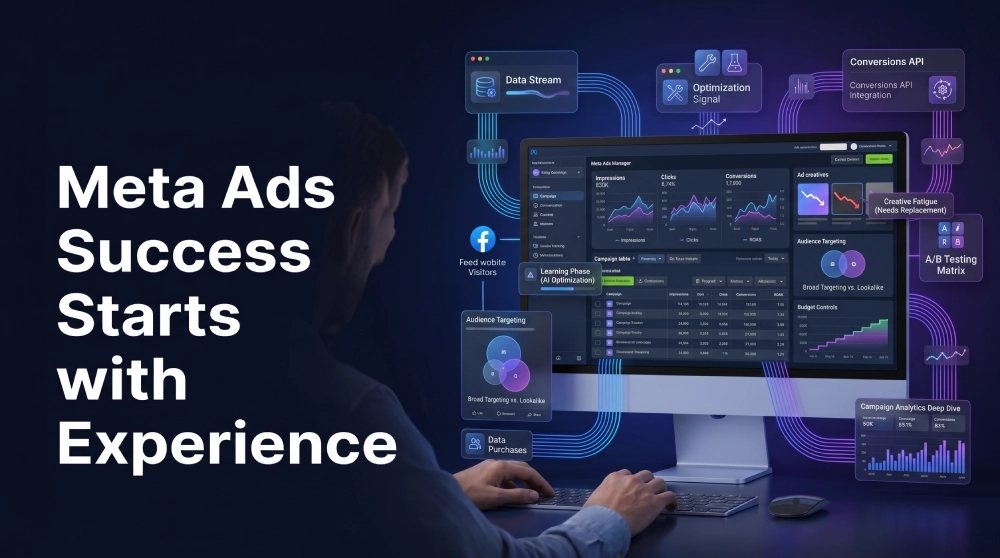
Reading documentation and running Meta Ads are distinct disciplines. At Xperts5, we have real insights into performance from managing campaigns across the USA by spending real budgets, analyzing the data, and optimizing the campaigns over time, and not just following the documentation.
Some patterns do emerge consistently.
Learning phase matters: If you change campaigns frequently, you reset the algorithm, which usually increases costs before performance returns to normal.
Creative fatigue sets in fast: Especially with Instagram Stories and Reels, where ads can go stale in weeks.
Broad targeting wins frequently: If you have enough Pixel data, then broad audiences with good creative will generally beat tight manual targeting.
Raise budgets slowly: Keeping budget increases to 20% or less stabilizes delivery, but a big leap can throw off performance.
You learn these lessons not from theory, but from real campaign management — which is often why businesses choose to hire a Meta Ads expert near you rather than run campaigns themselves.
Meta Ads vs. Google Ads
Both platforms serve different points in the customer journey:
Meta Ads are largely interruption-based, reaching people based on interests and behaviors while they are browsing socially, not actively searching for a solution. This makes Meta strong for awareness, discovery, and retargeting.
Google Ads are intent-based, capturing people who are actively searching for a product or service, making it strong for bottom-of-funnel, high-intent conversions.
Many businesses use both: Google Ads to capture existing demand and Meta Ads to build awareness and demand that eventually leads to that same search behavior.
Meta Ads Best Practices & Common Mistakes to Avoid
Editing campaigns too often restarts the learning phase and inflates costs
Targeting too narrowly starves the algorithm of enough data to optimize effectively
Ignoring the Conversions API leads to under reported conversions and poor optimization signals
Using only one creative format limits reach across different placements and increases fatigue
Scaling budget too aggressively disrupts delivery instead of improving results
Not separating testing from scaling campaigns — mixing creative testing with performance scaling makes it hard to isolate what's actually working
Meta Ads Case Study / Results
DTC Skincare Brand: Cutting CPA by 36% in 90 Days
A direct-to-consumer skincare brand came to Xperts5 running a single conversion campaign with narrow interest-based targeting and one static image ad. Over 90 days, on a monthly spend of roughly $3,000, we restructured the account around three changes:
Shifted to Advantage+ Shopping instead of manually segmented ad sets, letting Meta's algorithm handle audience discovery once enough Pixel and Conversions API data were flowing in.
Diversified creative formats, moving from one static image to a mix of carousel, short-form video, and UGC-style Reels, refreshed every 10 days to stay ahead of creative fatigue.
Slowed budget scaling, capping increases at 15–20% at a time instead of doubling spend after a few good days, to avoid resetting the learning phase.
Results after 90 days:
Metric | Before | After |
CPA | $42 | $27 |
CTR | 0.8% | 1.4% |
ROAS | 1.9x | 3.1x |
Monthly conversions | ~71 | ~111 |
The CPA drop came almost entirely from two things: letting Advantage+ Shopping find lower-cost-per-purchase audiences that manual targeting had missed and reducing creative fatigue by rotating formats on a fixed schedule instead of reactively.
Final Thoughts
Meta Ads reward advertisers who combine solid technical setup, proper pixel and Conversions API tracking, sensible budget pacing, and diverse creative with the patience to let the algorithm learn. The platforms constantly change (recent Meta Ads updates, like the Meta Ads Andromeda update, serve as a good reminder to keep an eye on Meta Ads news instead of relying on outdated advice), but clear objectives, genuine tracking data, and execution based on real performance never go out of style.
For your first campaign, start small, track everything through both the Pixel and the Conversions API, and resist making major changes before your account has enough data to tell you what's actually working.
Frequently asked questions
Most small businesses start with $10–$50/day, though the right budget depends on your objective and how quickly you want to exit the learning phase.
Neither is universally better. Meta Ads excel at awareness and discovery, while Google Ads capture existing search intent. Many businesses run both.
You do not need it for awareness or engagement campaigns, but it is essential for conversion-optimized campaigns and accurate retargeting.
Typically about 50 optimization events (like purchases or leads) per ad set within a 7-day window before delivery stabilizes, per Meta's own ad set delivery documentation.
Meta's hands-off, creative-heavy e-commerce campaign type, which allows AI to handle audience targeting, placement, and budget allocation without much manual configuration.
Yes. Meta offers a Meta Ads course and certification through Meta Blueprint, covering campaign setup, optimization, and measurement. A certification demonstrates baseline knowledge, but it's not a substitute for hands-on account management experience.
A Meta ad credit is promotional spend Meta occasionally offers to new or existing advertisers, usually tied to a minimum spend threshold within a set time window. Credits typically appear automatically in eligible ad accounts under Billing in Ads Manager rather than through a public application process.
The main Meta ad types are Awareness, Traffic, Engagement, Lead Generation, Conversions/Sales, and Advantage+ Shopping — each optimized for a different stage of the customer journey.
Ads Manager outages are rare and usually resolved within minutes; check Meta's official status page before assuming an outage, since most "down" reports are actually account-level delivery issues.