Selling products and hoping the customers will come is not a strategy anymore. You need a solid ecommerce marketing plan so you can stand out from the pack.Good stores use a combination of marketing techniques such as search engine optimization and paid advertising to reach their target audience.
At Xperts5, we help ecommerce stores across the USA with their marketing. We want to share the framework we use with our clients, including how customers actually make purchases, which types of marketing work best, and how to build a real strategy.
What Is Ecommerce Marketing?
Ecommerce marketing is the practice of marketing your online store through digital channels to attract the right customers. Unlike regular marketing, where you can’t see every single click, cart, and purchase in real time, it is different.
A good ecommerce digital marketing plan usually includes:
Search engine optimization
Pay-per-click advertising
Email marketing
Social media marketing
Content marketing
SMS marketing
Affiliate and influencer marketing
Conversion rate optimization
No single type of marketing can carry your store on its own. If you rely on just one way to sell, your store may have a hard time growing.
How Ecommerce Marketing Works
Ecommerce marketing works like a path customers follow, not a one-time push. Each stage of that path calls for a different kind of marketing, and treating every stage the same is a fast way to waste your marketing budget.
Awareness
A customer finds your store through a search, a social media post, or an ad. This first impression matters, since it often decides whether the customer stays or moves on. Search engine optimization, paid ads, and social media content do the most work at this stage.
Consideration
Now the customer looks closer, comparing your store to others, reading what past buyers say, and checking your return policy. At this stage, shoppers want proof your store can be trusted over the next one. Clear product details, honest reviews, and a fair returns policy all increase the odds of a sale.
Conversion and Retention
A purchase happens because checkout is simple and the product photos look good. Easy payment is often the deciding factor at this point. After the sale, repeat visits come from email follow-ups or a loyalty program that keeps your store top of mind. Every stage of ecommerce marketing plays a role in turning a first-time visitor into a repeat customer.
Types of Ecommerce Marketing Channels
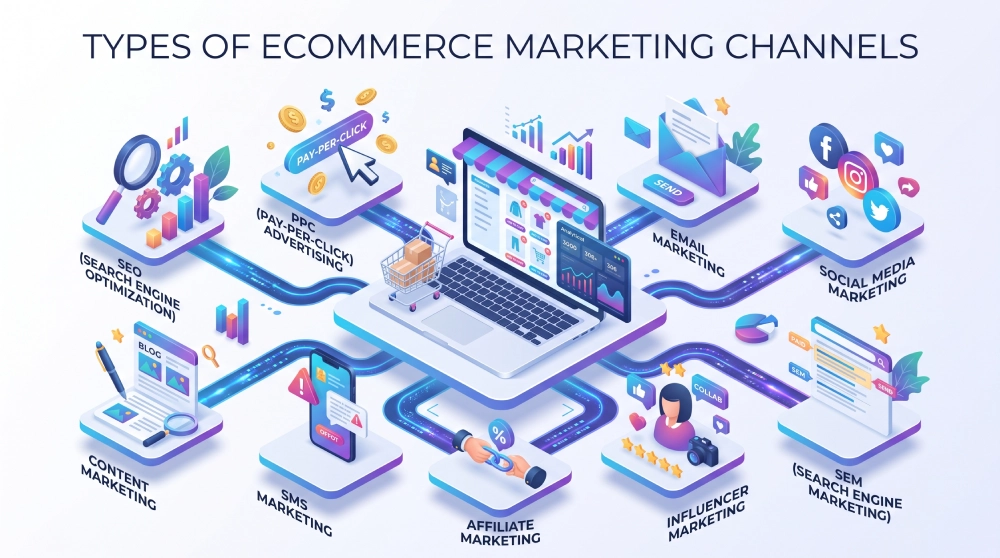
No single type of marketing can do everything on its own. A strong strategy combines several types of marketing, each covering a different part of the customer journey.
SEO
Improves organic visibility in search results. It’s slower to build than paid channels, but the traffic compounds and keeps coming long after the work is done. Many brands bring in an ecommerce search engine marketing agency to manage this long-term effort.
PPC Advertising
Put your ads in front of people already searching for what you sell. It’s the fastest way to get immediate traffic, especially for launches and promotions. This is core territory for ecommerce search engine marketing, since it captures demand at the exact moment someone is ready to buy.
Email Marketing
Automated personalised campaigns nurture leads and win back customers. Email marketing for ecommerce is one of the best ROI channels to drive repeat purchases, especially built around abandoned-cart flows, almost always.
Social Media Marketing
Builds brand awareness across Instagram, Facebook & TikTok and generates real traffic, but more difficult to link directly to a specific sale. The most effective ecommerce social media marketing happens when organic content and paid promotions are planned together, not separately.
Content Marketing
Guides and videos educating customers and feeding SEO. Ecommerce content marketing is a slower burn, but it builds trust in a way that ads simply can’t.
SMS Marketing
High open rates with direct-to-customer delivery. Best for really time-sensitive offers, as overdoing it will burn a list quickly. Ecommerce SMS marketing works best when reserved for flash sales, restock alerts, and shipping updates rather than everyday promotions.
Affiliate Marketing
Partners promote your products and earn a commission only when they drive results. It’s low-risk to test and performance-based by design, which is why ecommerce affiliate marketing is so popular.
Influencer Marketing
Show your products using real content creators. The key to great ecommerce influencer marketing is when the creator’s audience overlaps with your buyer.
SEM combines paid search with SEO to catch shoppers in a ready-to-buy mode.
SEM
Pairs paid search with SEO to reach shoppers already in ready-to-buy mode. It’s a complement to organic SEO, not a replacement.
Building a Strategy That Actually Moves Sales
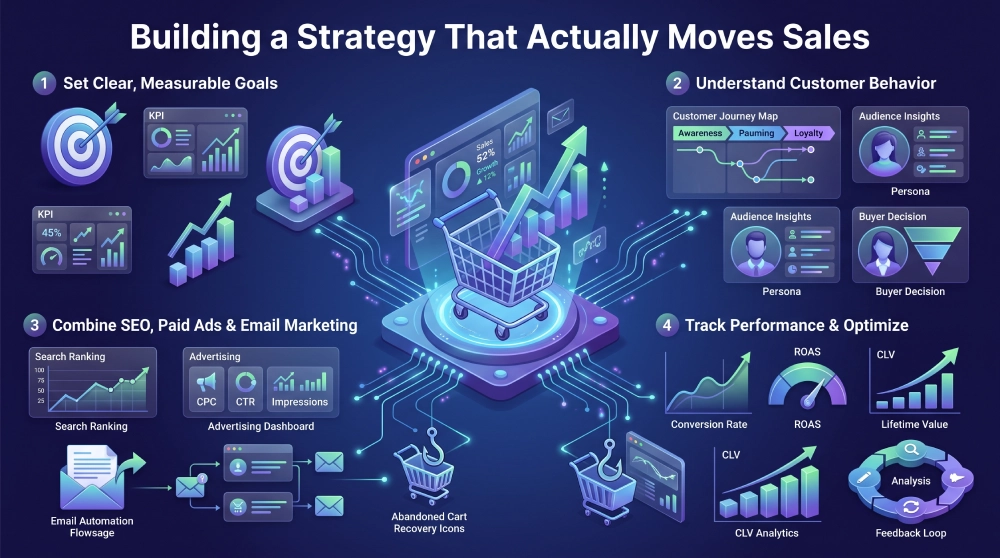
Every real ecommerce marketing strategy starts with a goal you can actually measure. Increased traffic isn’t one, but growing organic sessions 20% in Q2 is. From there, look past demographics and understand what actually makes your audience hesitate before buying. That insight is what shapes everything else.
SEO earns its place as the long-term, compounding channel, while paid ads step in when you need traffic right now, used deliberately rather than as a permanent crutch. Email deserves particular attention for abandoned-cart recovery alone, often the single highest-ROI automation a store can set up. None of this means much without tracking conversion rate, ROAS, and CLV, since a strategy is only as good as the feedback loop steering it.
Market Research and Choosing an Agency
Skipping market research before launch is how stores end up with inventory nobody wanted. Know your audience’s demographics, but also their buying triggers and objections. Study competitors’ pricing, positioning, and where their reviews complain. Validate demand with real keyword and search-trend data instead of assumptions, and settle on the unique selling point that makes you the obvious choice, not just another option, before picking channels. If you’re bringing in outside help, a few things separate agencies worth hiring from ones selling a template:
Real ecommerce experience: not just digital marketing in general, along with platform fluency in Shopify, WooCommerce, Magento, or BigCommerce
Services under one roof: meaning SEO, PPC, email, social, and analytics working together, with reporting you can actually read and verifiable case studies or client references you can check
Channel Comparison at a Glance
Channel | Best For | Time to Results | ROI |
SEO | Long-term organic traffic | 3–6 months | High |
PPC | Immediate sales | Immediate | Medium–High |
Customer retention | Days | Very high | |
Social Media | brand awareness & engagement | Weeks | High |
Content | Authority & SEO growth | 3–6 months | High |
SMS | Promotions & repeat purchases | Immediate | High |
Affiliate | Expanding reach | 1–3 months | High |
Influencer | Brand exposure & trust | Weeks | Medium–High |
ROI and timelines vary meaningfully by industry, price point, and existing traffic; treat this as a starting reference, not a guarantee.
Common Mistakes to Avoid
Stores that stall out tend to repeat the same mistakes:
Betting everything on one channel instead of balancing SEO and paid traffic
Targeting too broad an audience instead of a defined buyer
Writing thin product descriptions and neglecting mobile users
Skipping cart-recovery emails
Ignoring KPIs and customer reviews until revenue drops
Costs and What to Measure
Costs vary by business size, competitiveness, and scope, so treat the table below as a broad market reference rather than a fixed quote. Working with a digital ecommerce marketing agency almost always costs less than the revenue lost to an underperforming, uncoordinated channel mix.
Service | Monthly Cost (USD) |
SEO | $800–$5,000 |
Email Marketing | $300–$2,000 |
Social Media Marketing | $500–$5,000 |
Content Marketing | $800–$4,000 |
SMS Marketing | $200–$1,500 |
Full-service ecommerce marketing | $2,500–$15,000+ |
.
Once you’re running campaigns, a handful of metrics actually matter:
Website traffic by source and conversion rate: which gives the clearest read on your funnel
CAC and ROAS: showing what each customer costs versus what each ad dollar returns
CLV and AOV: where CLV should drive budget decisions since it shows a customer’s worth beyond the first purchase
Expert Tips to Improve Ecommerce Marketing Results
Improving ecommerce marketing results takes a strategic, consistent approach. Focus on understanding your target audience, optimizing your website for speed and mobile users, and creating content that supports both SEO and customer engagement. Combining multiple marketing platforms means more people to reach and more sales to make. You’ll want to review key performance indicators regularly and adjust campaigns as data dictates. That’s what produces long-term growth and ongoing development.
Get Started With Ecommerce Marketing Today
Ready to grow your online store? Xperts5 builds custom ecommerce marketing services to help drive traffic, boost sales, and get more out of your marketing budget. Reach out to Xperts5 today, and let’s figure out what that could look like for your business.
Frequently asked questions
Ecommerce marketing is the process of driving traffic to and sales from an online store via digital channels like SEO, PPC, email, social media, SMS, content marketing, and affiliate marketing.
Long-term, SEO and email usually come out on top since you’re not paying per click or per send once things are running. But honestly, it depends where your store’s at. Brand new with no traffic yet? Paid ads will probably get you moving faster.
Full-service agencies generally land somewhere between $2,500 and $15,000+ a month. That’s a big range though, so don’t take it as a quote. What you’ll actually pay depends on scope, how competitive your niche is, and what you’re trying to accomplish.
Because without it, you’re guessing. Research tells you whether people actually want what you’re selling, what your competitors are up to, and which keywords are worth chasing before you spend a dime.
Yes, but not usually by trying to outspend them. Smaller stores often do better competing on niche targeting, ecommerce social media marketing that feels personal rather than corporate, and customer experience rather than ad budget alone.
Depends on the channel. Paid ads can start showing results within days. SEO and ecommerce content marketing usually take 3-6 months to get traction. In practice, a strategy is often a combination of these two: paid to get traffic immediately, organic to compound that growth.
Yes, but not usually by trying to outspend them. Smaller stores often do better competing on niche targeting, ecommerce social media marketing that feels personal rather than corporate, and customer experience rather than ad budget alone.
Putting everything into one channel. The moment that channel slows down, whether it’s an algorithm shift or rising ad costs, revenue takes a direct hit. Spreading across a few channels, even smaller ones like ecommerce affiliate marketing, softens that blow.
Track conversion rate, Customer Acquisition Cost, and Customer Lifetime Value together rather than any single metric in isolation the same dashboard any solid digital marketing agency for ecommerce would build for you.