At Xperts5, we work daily with companies trying to figure out if outsourcing makes sense for their business, and the honest answer is it depends on what you outsource and who you outsource it to. The right BPO service provider can mean the difference between true cost savings and a painful vendor relationship, which is why so many companies spend weeks comparing their options before making a decision. This BPO services guide contains everything you need to know in 2026, from the types of BPO services available (customer service BPO, back office support), how pricing works, what quality really depends on, and how to choose a partner that suits your business and not just your budget.
What are BPO Services?
BPO Business Process Outsourcing is outsourcing of business processes to a third party provider. It could be customer service, accounting or help desk stuff in IT. The aim is straightforward: a specialist bpo services company takes over routine or resource-heavy processes, freeing up your internal team to concentrate on vital business goals.
Why Businesses use BPO Services
Companies look to a BPO service provider for a number of common reasons: cost savings, access to trained talent, scalability, and 24/7 coverage without the overhead of developing an internal department. Many US companies also outsource because it is faster to scale a support team with an established BPO services provider than it is to hire and train dozens of new employees in-house. That speed advantage alone can be the difference for fast-growing companies.
Types of BPO Services
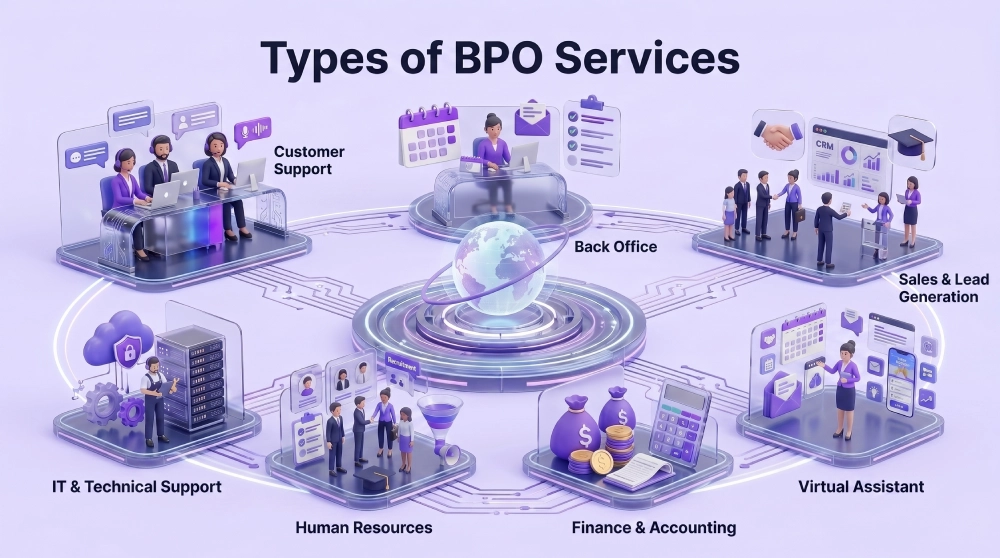
There are several types of BPO services, each designed to handle a different function within a business.
Customer Support Services
Customer service BPO is one of the most common outsourcing categories. It offers live chat, email, and trained agent phone support for your brand.
Back Office Services
Back office BPO services include data entry, order processing, documentation and records management, all the things that make the operations run smoothly behind the scenes.
Sales & Lead Generation Services
Outsourced sales teams handle prospecting, cold outreach, appointment setting, and lead qualification so that internal sales teams can focus on closing deals.
Virtual Assistant Services
Virtual assistants serve busy executives and small teams in administrative roles such as scheduling, inbox management, research, and day-to-day coordination.
Finance & Accounting Services
Finance and accounting BPO services: bookkeeping, payroll processing, invoicing, tax preparation, financial reporting. A lot of companies go for accounting BPO services to reduce errors and keep compliance without setting up a full finance department of their own.
Human Resources Outsourcing
Outsourcing HR functions like hiring, training, benefit administration, and compliance can be a way for smaller companies to get HR help they can’t afford to have on staff.
IT & Technical Support Services
IT outsourcing is providing helpdesk support, software maintenance, network monitoring, and technical troubleshooting for internal teams or end customers.
Benefits of BPO Services
Finding the right outsourcing partner can add real measurable value to a business. But the benefits can vary with the size of the business.
Benefits of BPO Services by Business Size
Size of Business | Main Benefits |
Startups | Cheaper, faster growth without staff hires |
Small & Mid-Size Businesses | access to specialized talent (finance, HR, IT) without paying full-time salaries |
Large Enterprises | operational efficiency, 24/7 coverage, and a global reach |
Businesses save money and can expand or contract their teams as needed, while also having access to industry-specific knowledge that would take years to develop in-house.
How to Choose a BPO Service Provider
There are different BPO service providers out there, and picking the wrong one could cost you more than it saves you. When choosing a BPO services company, look at their years of experience, data security measures, the number of clients they have, and communication. A good BPO provider will have clear SLA’s, clear reports, a single point of contact for each client, and not just a call center with standard scripts.
BPO Services vs In-House Teams
Whether you hire an outside team or outsource the work rests on your budget, your need for control, and how important the task is to your business.
Factor | BPO | In-House |
Cost | Lower operational cost | Higher salary and infrastructure cost |
Scalability | Fast, flexible scaling | Slower, requires hiring cycles |
Control | Shared, vendor-dependent | Full internal control |
Expertise | Access to specialized skills instantly | Requires training and development |
Neither option has a clear winner. A lot of organizations are going for a hybrid model where the core functions are kept in-house, and the repetitive or specialized work is outsourced.
Insights from Real-World BPO Experience
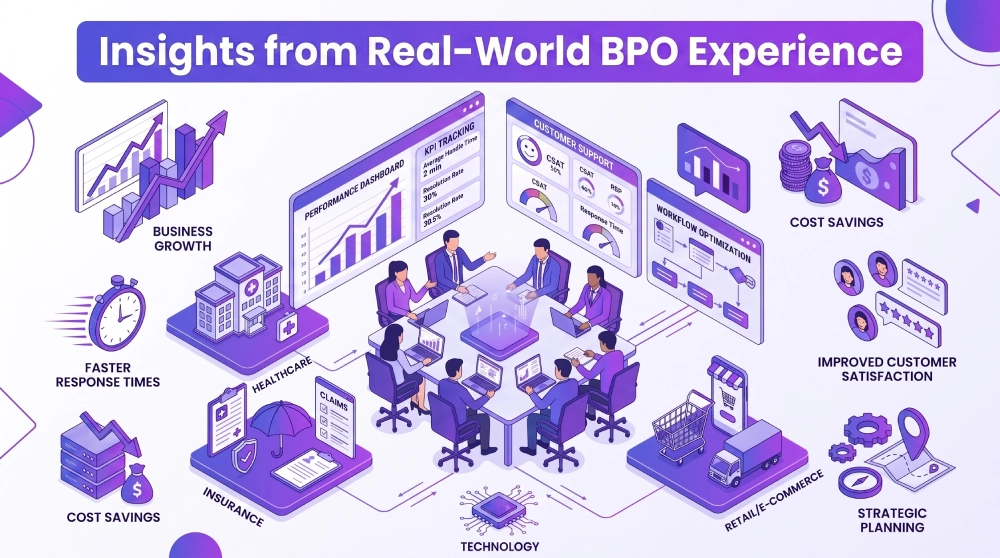
At Xperts5, we’ve helped businesses across healthcare, insurance, and retail transition from in-house operations to outsourced teams, and the results vary more than most guides admit. One mid-size e-commerce client saw a noticeably leaner support budget within the first six months of switching to a dedicated BPO contact center services team, along with a drop in average response time from 24 hours down to under 4. On the flip side, we’ve also seen engagements stall in the first few weeks simply because the client didn’t define clear KPIs upfront, a reminder that outsourcing success depends as much on the client’s preparation as on the vendor’s capability. These are the kinds of lessons that only show up after running real engagements, not just reading about them.
BPO Pricing Models: What Businesses Typically Pay
Understanding how a BPO service provider actually prices its services makes it much easier to budget and compare vendors fairly.
Common BPO Pricing Models
Pricing Model | How It Works | Typical Cost | Best For |
Per-seat pricing | Fixed monthly rate per agent | $1,200–$2,500 per seat/month | Customer service BPO companies, contact centers |
Per-transaction pricing | Cost tied to volume of work completed | $0.50–$3 per ticket/document | Back office BPO services |
FTE-based pricing | Billing based on full-time-equivalent staff | $1,500–$4,000 per FTE/month | Finance and accounting BPO services |
Outcome-based pricing | Fees tied to results, not hours worked | Varies by outcome | Sales, lead generation, claims processing |
Pricing for BPO services in the USA typically runs higher than offshore alternatives due to labor costs, sometimes double or triple offshore rates, but often comes with fewer communication barriers and closer time-zone alignment. If you are considering accounting BPO services or financial BPO services, then also ask if compliance and audit support is included in the price, as this may be an additional fee that is charged by the provider.
Tools Used in BPO Services
Modern BPO contact center services and back office operations require a stack of specialized software to be efficient and accountable.
Typical Tools Used in BPO Operations
Customer Support Tools: teams use Zendesk, Freshdesk, and LiveChat to handle tickets and customer interactions across chat, email, and phone.
CRM & Sales Tools: Salesforce and HubSpot help monitor leads, customer interactions, and sales pipelines.
Communication & Collaboration Tools: Slack, Microsoft Teams, and Zoom keep outsourced teams and in-house stakeholders talking in real time.
Project Management Tools: Asana, Trello, and Monday.com track deliverables, deadlines, and workflows between client and vendor.
Workforce Management Tools: Genesys and NICE WFM manage scheduling and staffing, especially for BPO contact center services running 24/7.
Reporting & Analytics Tools: Power BI and Tableau monitor KPIs such as response time, resolution rate and customer satisfaction.
Factors That Affect BPO Service Quality
Signing a contract doesn’t ensure quality is going to happen. The key is clear SLAs, the vendor’s training and retention of agents, and performance measurement using KPIs such as average handle time, first call resolution, and customer satisfaction. A good BPO service provider should be one that is open to frequent communication and reporting from both ends, rather than a provider that is silent but does not deliver what was expected.
Common Mistakes to Avoid in BPO Outsourcing
Many businesses don’t fail because of outsourcing, but because of the management of outsourcing. Typical errors are:
Price only: Cheaper seller, more turnover, less training, less consistent quality of service.
Not having clear KPIs in the first place: if you don’t have defined metrics, you can’t measure if the partnership is really working.
Skipping onboarding: rushing agents through training means they don’t get a grasp of your brand, products, or customers.
Set it & leave it: Outsourcing is not a one-time handoff; it is an ongoing dialogue.
Not following data security best practices: By not vetting a vendor’s compliance and security standards, you can create serious risk, especially for finance and healthcare data.
Industries That Benefit from BPO Services
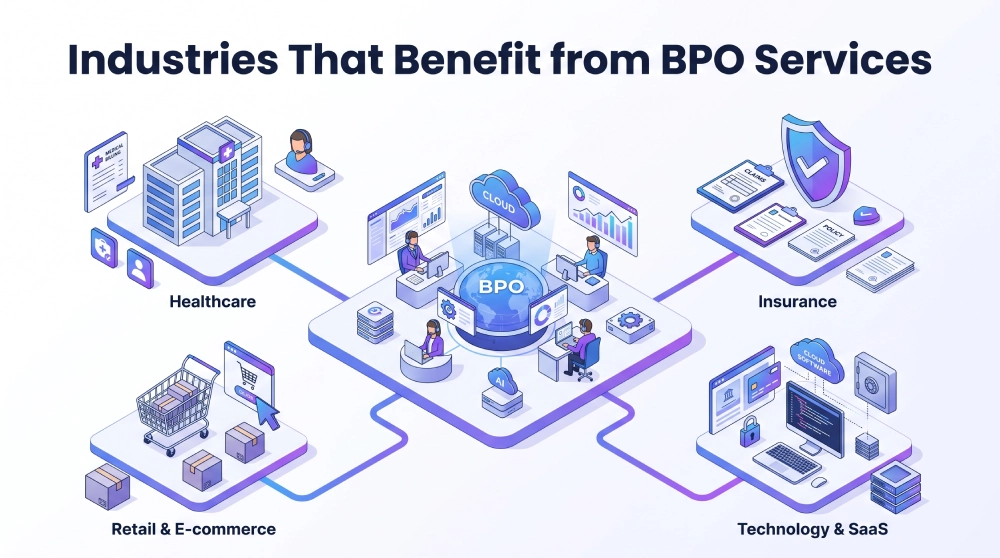
Outsourcing is not industry-specific. It can be done for almost all industries.
Healthcare
Healthcare BPO services help hospitals and clinics manage medical billing, claims processing, and patient support without putting pressure on their internal staff.
Insurance
Insurance BPO services are equally common and include policy administration, claims processing, and customer queries. Many vendors have now specialized in only BPO insurance services and have a depth of regulatory knowledge that generalist vendors can’t match.
Retail, E-commerce, Banking & Technology
Retail, e-commerce, banking and technology companies also widely use outsourcing for customer support and back-office functions.
Future Trends in BPO Services
The BPO industry is changing rapidly. Automation and chatbots are taking care of the more mundane work, leaving human agents to make the more complex decisions. Nearshoring is gaining momentum as more companies work with providers in Latin America to better align with time zones. At the same time, the demand for finance BPO services and financial BPO services continues to rise as companies look for tech-enabled and compliance-ready outsourcing partners, rather than cost-driven vendors.
Final Thoughts
The right BPO partner and proactive engagement in managing the relationship can be a real competitive advantage. Be it customer service BPO, back office support, or specialised finance and accounting BPO services, the key is to look at outsourcing as a strategic partnership and not just a quick fix to cut costs.
Frequently asked questions
BPO stands for Business Process Outsourcing. It is when you outsource a business function that would otherwise be done in-house to a third-party BPO service provider. This could be customer support, accounting, IT, etc.
The BPO service provider helps companies save money, get trained talent, scale faster, and have 24/7 coverage, all without the overhead of building out an internal department.
The major types of BPO services include customer support, back office processing, sales and lead generation, virtual assistance, finance and accounting BPO services, HR outsourcing, and IT support.
Some of the key benefits are reduced operational costs, access to niche talent, faster scalability, and 24x7 operational coverage. The specific benefit is often associated with the business size as discussed in the comparison table above.
A BPO services provider should be evaluated on industry experience, data security measures, client references, transparent reporting and clear SLAs, not just on price.
It all depends on how core the function is to your business, your budget, and your need for control. Many companies are under a hybrid model where they do the strategic work in-house and outsource the repetitive work to a BPO services company.
Per-seat $1,200-$2,500/mo. Per Ticket: $0.50 - $3.00 per transaction. $1,500-$4,000/mo. Per FTE. Outcome-based: variable. BPO services in the USA are more expensive than offshore because of labor but with better time zone fit.
The quality of BPO services depends on the degree to which SLAs are specified, the quality of training and retention of the vendor’s agents, and the degree to which performance is tracked using KPIs like first call resolution and average handle time.
Healthcare BPO services and insurance BPO services are the most common. Retail, e-commerce, banking, and technology companies are also outsourcing customer support and back-office functions.
It can be, as long as the vendor adheres to strict data security and compliance requirements specific to your industry; this is especially critical for accounting BPO services and BPO insurance services.